
- September 13, 2026
- Posted by: webmaster
- Category: Blog
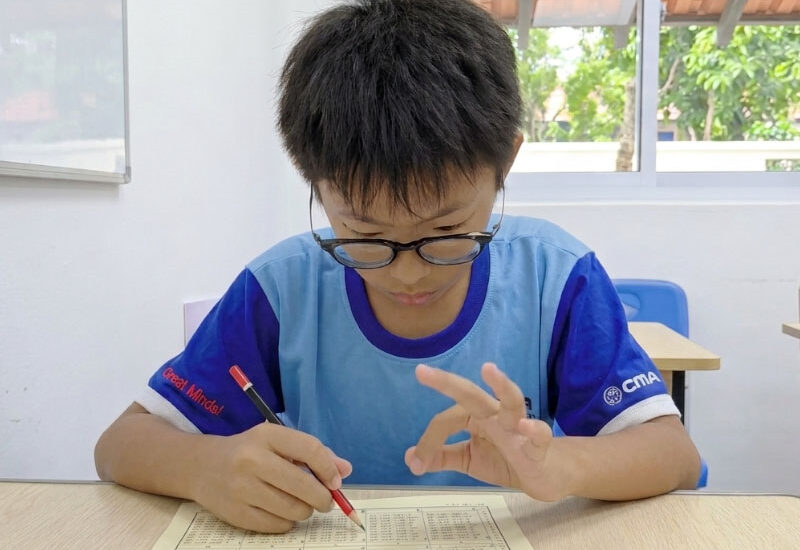
If you have been researching abacus class options in Singapore, you may have noticed that not all programmes teach abacus the same way. One of the most significant differences between abacus methods is something that many parents overlook entirely: whether children use one hand or both hands to move the beads.
This distinction matters more than it might appear. The hand a child uses, and whether both hands are engaged simultaneously, has a direct effect on which parts of the brain are activated during every session. Understanding this difference can help parents make a more informed choice about which abacus programme is genuinely doing more for their child’s cognitive development.
What Is the Dual-Hand Abacus Method?
The dual-hand abacus method, sometimes described as the bimanual approach, involves training children to use both their left and right hands simultaneously when operating the abacus. Rather than using one dominant hand to move beads while the other remains passive or idle, children in a dual-hand programme actively engage both hands throughout each calculation.
This might seem like a small technical detail, but the implications for brain development are significant and grounded in how the brain is structured and how it responds to physical input from the body.
Why Does Using Both Hands Matter for Brain Development?
The brain is organised in a cross-lateral pattern, meaning the left hemisphere of the brain primarily controls the right side of the body, and the right hemisphere primarily controls the left side. This means that when a child uses their right hand, the left hemisphere of the brain is activated. When a child uses their left hand, the right hemisphere is activated.
In a single-hand abacus approach, most of the physical movement comes from one hand, typically the dominant hand. This means the hemisphere on the opposite side of the brain is doing most of the work during each session, while the other hemisphere remains relatively less engaged by the physical task.
In a dual-hand abacus approach, both hands are active at the same time. This means both hemispheres of the brain are being stimulated simultaneously during every calculation. The left hemisphere handles the logical, sequential, and analytical aspects of the arithmetic, while the right hemisphere manages the spatial awareness, visual tracking, and pattern recognition involved in moving beads on the abacus. Both hemispheres are engaged, and they are required to coordinate and communicate with each other throughout the process.
What Does Each Hemisphere Contribute During Abacus Training?
Understanding what each side of the brain is doing during a dual-hand abacus session helps clarify why this method is more cognitively demanding and developmentally richer than a single-hand approach.
The left hemisphere contributes the logical processing of arithmetic formulae, the sequential application of addition and subtraction rules, and the recall of memorised methods. It manages the structured, step-by-step thinking that underpins accurate calculation.
The right hemisphere contributes the spatial and visual processing of bead positions on the abacus frame, the recognition of patterns in numerical sequences, and the broader sense of where quantities sit in relation to each other on the tool. It manages the intuitive and visual aspects of the calculation process.
When both hemispheres are working together in a coordinated way during every session, children are not just practising arithmetic. They are actively building the neural pathways that connect logical and visual thinking, which is what makes learning more flexible, more efficient, and more transferable across other subjects and situations.
How Does This Progress Into Mental Arithmetic?
The dual-hand method becomes even more significant when children advance from physical abacus training to mental arithmetic, the stage where calculations are performed entirely in the mind without the physical tool.
At this advanced stage, children must recall and mentally visualise the abacus from memory, and use that imagined image to perform calculations in their heads. The right hemisphere does the heavy lifting of maintaining and manipulating the mental image of the abacus, while the left hemisphere continues managing the arithmetic logic and the step-by-step calculation process.
Children who have trained with both hands from the beginning have already been developing both hemispheres consistently throughout their abacus journey. By the time they reach the mental arithmetic stage, the right hemisphere’s capacity for spatial visualisation and mental imagery is significantly more developed than it would be in a child who trained with only one hand. This makes the transition to mental arithmetic smoother, more natural, and ultimately more effective.
Why Does CMA Singapore Use the Dual-Hand Method?
CMA Singapore’s programmes are built around the dual-hand abacus system as a core part of their methodology, not as an optional addition. From the very first lesson in the Kindy Programme for children aged 3, children are taught the correct posture and dual-hand bead technique that engages both hemispheres from the start of their learning journey.
This commitment to whole-brain engagement through bilateral hand training is one of the defining characteristics of CMA’s abacus class in Singapore and what distinguishes the programme from single-hand approaches. As children progress through the Foundation, Intermediate, Advanced, and Dan Levels of the Primary Programme, the dual-hand methodology remains central to how every level is taught and how mental arithmetic visualisation is developed.
Parents looking for an abacus class in Singapore that does more than teach calculation, one that actively develops both sides of the brain through a structured and progressive bilateral training system, will find that CMA’s dual-hand approach offers a meaningfully different and more cognitively comprehensive learning experience.
If you would like to find out more about CMA’s programmes and which level is right for your child’s age and stage, visit our centres or speak with our team directly.
Frequently Asked Questions (FAQ)
Q1: What does bilateral hand coordination mean and why is it important for children?
Bilateral hand coordination refers to the ability to use both hands together in a controlled and coordinated way during a task. It is important for children because it requires both hemispheres of the brain to communicate and work simultaneously, which strengthens the neural connections between the logical and visual-spatial areas of the brain that underpin learning across many subjects and everyday activities.
Q2: Is the dual-hand abacus method harder to learn than the single-hand method?
It requires more initial coordination practice, particularly for younger children who are still developing fine motor skills, but it is not significantly harder when introduced gradually within an age-appropriate programme. Young children who begin with the dual-hand method from the start adapt naturally over time. The added cognitive engagement that comes with using both hands is precisely what makes the method more developmentally effective despite the slightly steeper early learning curve.
Q3: My child is left-handed. Will the dual-hand abacus method still work the same way for them?
Yes, the dual-hand abacus method is equally effective for left-handed children. Because both hands are actively engaged during every session, handedness does not create a disadvantage in dual-hand abacus training the way it might in single-hand approaches. Both hemispheres of the brain are stimulated regardless of which hand is dominant, and the cross-lateral activation principle applies equally to left-handed and right-handed learners.
Q4: Are there other activities besides abacus that also develop both sides of the brain simultaneously?
Yes, activities such as learning a musical instrument, swimming, and certain forms of drawing or craft that require coordinated use of both hands also engage both brain hemispheres to varying degrees. However, the dual-hand abacus method is distinctive in that it combines bilateral physical coordination with structured numerical and logical processing simultaneously, making it one of the few activities that develops both hemispheres within a single, academically relevant cognitive task.
Q5: Can a child who previously learned single-hand abacus switch to the dual-hand method at CMA Singapore?
Yes, children who have learned abacus through a single-hand approach can transition to CMA Singapore’s dual-hand programme. A diagnostic assessment helps determine the appropriate entry level based on the child’s existing skills. Some adjustment period is expected as the child learns to coordinate both hands, but trainers guide this transition progressively to ensure the child builds confidence with the new technique before advancing.