
- November 16, 2026
- Posted by: webmaster
- Category: Blog
Many parents share the same hope: “I want my child to feel confident and do well in maths. Can enrichment help?” It is a sensible question, and the answer starts with how children actually work through maths problems.
This article explains how math enrichment builds the mental skills behind school maths, how abacus mental arithmetic does this, and where it fits alongside school and tuition.
What Is Math Enrichment, and How Does It Relate to School Maths?
School maths follows the national syllabus set by the Ministry of Education (MOE). Teachers introduce concepts such as fractions, measurement and problem-solving methods, and children practise them in class and at home.
Math enrichment adds something different. Instead of covering more syllabus topics, many programmes strengthen the skills a child uses every time they do maths, such as number sense, calculation and concentration. Our abacus mental arithmetic programmes at CMA Singapore are designed to work alongside what your child learns in school, building the mental skills that make that learning easier to apply.
How Do Mental Skills Show Up in Primary School Maths?
Every maths question asks a child to do two things at once: understand what is being asked, and handle the numbers involved. When the number work takes a lot of effort, less mental energy is left for thinking about the problem itself.
Three skills matter most.
Mental calculation. A child who can add, subtract and work with numbers confidently in their head spends less effort on the arithmetic steps. Mathematics Paper 1 in the PSLE does not allow calculators, so working with numbers independently remains part of what children are expected to do.
Processing speed. This is how quickly and accurately a child takes in information and responds. In timed papers, a child who processes numbers and instructions efficiently has more time to check their work.
Pattern recognition. Spotting how numbers relate, such as how they combine, split apart or follow a sequence, helps children approach unfamiliar questions with more flexibility.
Stronger skills in these areas give a child a better base for everything school maths asks of them.
How Does Abacus Mental Arithmetic Build These Skills?
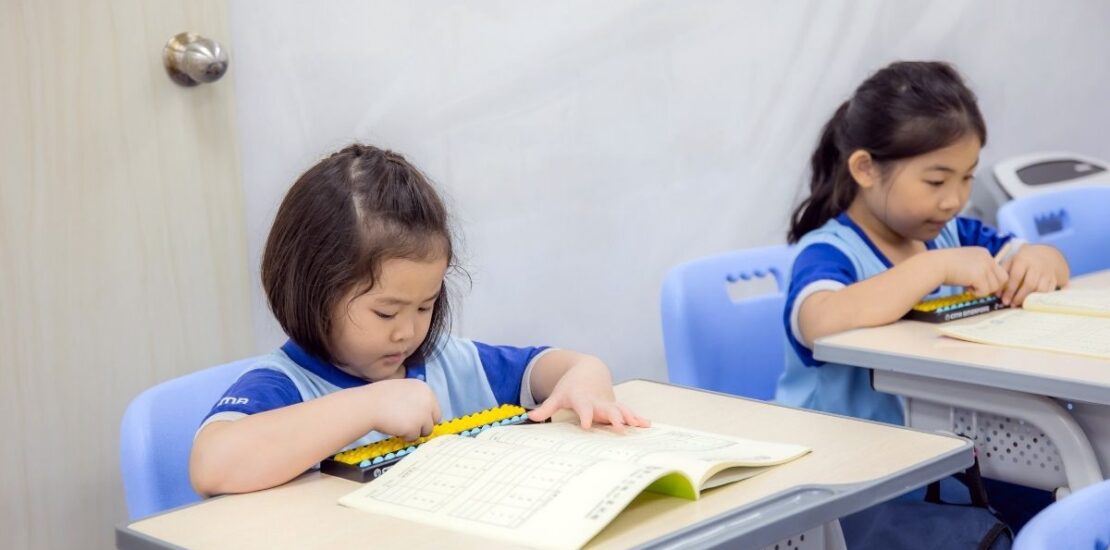
Abacus mental arithmetic gives children regular, structured practice with these skills. We use a dual-hand abacus method, and children progress through stages:
- Abacus Arithmetic: children calculate on the physical abacus, building focus and a feel for how numbers work.
- Mental Arithmetic: children use what they have learned to calculate without the physical tool, which builds rapid processing.
- Aural Mental Arithmetic: children respond to numbers they hear, which builds active listening.
- Mental Visualisation: children picture an imaginary abacus in their minds, which strengthens memory.
- Timing Challenge: working within time limits builds discipline and steadiness.
We call these five outcomes BRAIN: Better Focus, Rapid Processing, Active Listening, Increase Memory Power and Nurtured Discipline. Because every session asks for active effort, children use their number sense, memory and concentration again and again. These are general learning skills that can support maths and other subjects.
What Does the Research on Our Programme Show?
Research on our programme was carried out in 2010 by researchers from the National University of Singapore, working with 180 CMA students aged 5 to 8 at beginner, intermediate and advanced levels. The children solved addition and subtraction problems in different conditions, and the paper was later published in Frontiers in Psychology in 2018.
The researchers found that beginners were comfortable with the physical abacus but found mental arithmetic harder, intermediate learners relied on abacus hand movements to calculate mentally, and advanced learners could calculate mentally and did just as well without moving their hands. In other words, children’s mental picture of the abacus develops as they progress through the levels.
What Else Helps a Child Get Stronger at Maths?
Children tend to do best when several things work together:
- Understanding concepts at school. Classroom teaching and any tuition build the content knowledge.
- Confidence with numbers. Comfortable children are often more willing to attempt harder questions.
- Focus and listening. A child who can concentrate gets more from every lesson.
- Regular, relaxed practice. Short, steady practice usually beats occasional long sessions.
- Healthy habits at home. Enough sleep and balanced screen time help children concentrate.
Enrichment adds to this picture by building the confidence, focus and calculation skills a child brings to their maths lessons.
What Changes Can Parents Look For?
Every child progresses at their own pace, and school results depend on many factors, so we do not promise specific marks. Parents often notice changes in everyday behaviour first, such as greater comfort with numbers, better concentration during homework or more willingness to try difficult questions.
As calculation becomes easier, a child can spend more of their effort on understanding the problem itself, which is where school maths asks the most of them.
How Do Enrichment and Tuition Work Together?
Tuition helps with the school syllabus and exam techniques, while math enrichment builds the mental skills that support learning. Many families use both, as long as the weekly schedule leaves room for rest and play.
If your child needs more help understanding basic school maths concepts first, our sister brand, TSC Education Lab, uses a story-based approach to introduce mathematics concepts before moving into abacus training. Our team can advise on availability.
How Does CMA Support Primary School Children?
Our programmes run from age 3 to 13. The Kindy Programme (ages 3 to 4.5) uses songs and physical activities in a stress-free setting, with a maximum of 8 students per class. The Kinder Programme (ages 4.5 to 6) builds dual-hand abacus foundations, and children take a diagnostic test to check readiness. The Primary Programme (ages 7 to 13) trains children in both Abacus Arithmetic and Mental Arithmetic, moving through Foundation, Intermediate and Advanced levels towards the Dan Levels.
Progression is ability-based, so children advance when they are ready and the challenge stays suitable.
Final Thoughts
Math enrichment helps a child become faster, more confident and more focused with numbers, which supports their learning in the classroom and beyond. Starting early gives children more time to build these skills.
If you would like to see which programme suits your child’s age and stage, visit one of our centres near you and our team will be happy to guide you.
Frequently Asked Questions (FAQ)
Q1: What age is suitable to start math enrichment in Singapore?
Children can start from age 3. Our Kindy Programme is designed for ages 3 to 4.5, and our Kinder and Primary Programmes continue up to age 13. Starting earlier gives children more time to build skills, but older children can still join at a level that suits them.
Q2: How is abacus math enrichment different from maths tuition?
Tuition focuses on the school syllabus and exam techniques, while abacus mental arithmetic builds skills such as calculation confidence, focus and processing speed. The two serve different purposes. Many families use both, as long as the weekly schedule leaves enough time for rest and play.
Q3: Is math enrichment suitable for a child who is already good at maths?
Yes, it can suit children at any level. Strong students can use abacus mental arithmetic to build faster calculation, sharper focus and stronger memory. Because our programmes are ability-based, each child starts at a level that suits their current skills and advances when ready.
Q4: Can math enrichment help a child who finds maths difficult?
It can help build number sense and confidence with numbers, which makes maths feel less daunting. It is not a replacement for school or tuition support on specific topics. If your child first needs help with basic concepts, TSC Education Lab uses a story-based approach, and our team can advise on availability.
Q5: How often are the classes, and how long is each lesson?
Our Kindy Programme runs weekly one-hour sessions with a maximum of 8 students per class. The Kinder and Primary Programmes run in 10-week terms with weekly sessions of 1.5 hours. A weekly rhythm helps children build skills steadily without overloading their schedule