
- July 3, 2026
- Posted by: webmaster
- Category: Blog
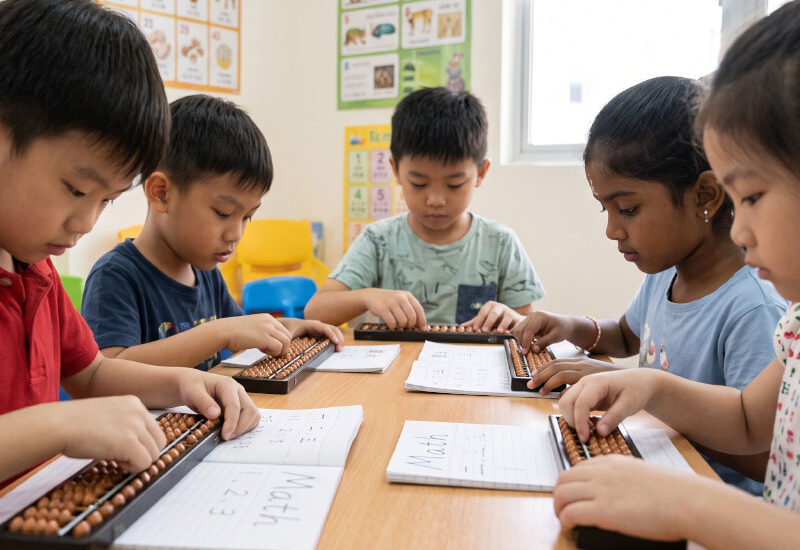
If you have ever compared notes with other parents in Singapore, you have probably heard both “abacus class” and “math tuition” mentioned as solutions for helping a child do better in mathematics. While both can support a child’s learning, they are not interchangeable. Each works on a different part of how a child learns, and knowing the difference can help you choose what your child actually needs.
What Does Math Tuition Focus On?
Math tuition in Singapore is generally built around the school syllabus. A tuition teacher works through the same topics your child is learning in class, whether that is fractions, geometry, or algebra, and helps reinforce understanding through practice, revision, and exam techniques.
Tuition is especially useful when a child is:
- Struggling to keep up with a specific topic in school
- Preparing for upcoming exams or national assessments
- Looking to move ahead of the syllabus for a stronger foundation
In short, math tuition is content-driven. It strengthens what a child already needs to know for school, and its value is closely tied to the curriculum being taught at that point in time.
What Does an Abacus Class Actually Train?
An abacus class in Singapore works differently. Rather than focusing on specific school topics, it trains the underlying mental skills that make learning, in general, easier. Through structured practice with the abacus and later, mental visualisation of it, children gradually build up:
- Attention and concentration span
- Working memory
- Mental processing speed
- Numerical sense and confidence with numbers
These are not subject-specific skills. They are foundational abilities that support how a child absorbs and processes information across all subjects, not just mathematics. This is why an abacus class is often described as training the “mental architecture” behind learning, rather than teaching content directly.
Because abacus training is built on consistent, levelled practice over time, the benefits tend to show up gradually rather than immediately after a single test or exam.
Why Parents Often Confuse the Two
The confusion is understandable. Both abacus class and math tuition involve numbers, both happen outside regular school hours, and both are commonly searched for by parents wanting to help their child do better with mathematics. On the surface, they can look like two versions of the same thing.
In reality, one is about reinforcing what is being taught (tuition), while the other is about strengthening the mental tools used to learn anything (abacus training). A helpful way to think about it is that tuition helps your child catch up or move ahead in a subject, while abacus training helps your child learn more efficiently across the board.
Can Abacus Class and Math Tuition Work Together?
Yes, and many families in Singapore use both at different stages or even alongside each other. There is no conflict between the two because they are not solving the same problem.
For example, a child might attend an abacus class on weekends to build long-term concentration, memory, and numerical confidence, while also attending tuition during the school term to stay on top of specific syllabus content. Over time, parents often notice that children with stronger concentration and mental processing find it easier to follow tuition lessons and retain what they learn, since the abacus training supports the learning process itself.
This complementary relationship is one reason many parents introduce abacus class earlier, often during preschool or early primary years, before academic demands and tuition needs increase.
Which One Should You Start With?
If your child is currently facing difficulty with a specific school topic or has an upcoming exam, tuition is the more immediate and direct solution.
If you are thinking further ahead and want to give your child a stronger overall learning capacity, attention span, and confidence with numbers, an abacus class is worth considering, especially if introduced while your child is still young. Early childhood is widely recognised as a particularly responsive period for developing concentration and memory skills, which is part of why many abacus programmes accept children from preschool age.
Final Thoughts
Abacus class and math tuition are not competitors. They serve different roles in a child’s learning journey, one focused on subject content, the other on the mental foundation that makes learning easier overall. Understanding this difference allows parents to make a more informed choice, rather than assuming one can simply replace the other.
For families in Singapore exploring abacus class options, CMA Singapore offers structured, ability-based abacus mental arithmetic programmes designed to build concentration, memory, and numerical confidence from a young age, complementing whatever academic support your child may already be receiving.
Frequently Asked Questions (FAQ)
Q1: Can my child take an abacus class and math tuition at the same time?
Yes, many children attend both without issue. Abacus class and tuition focus on different things, so they do not overlap or compete. Many parents schedule abacus class on weekends and tuition during weekday afternoons or evenings.
Q2: What age should my child start abacus class in Singapore?
Our abacus programmes accept children from as young as 3 to 4 years old, with structured levels for preschool and primary school ages. Starting early allows children to build concentration and number sense gradually, before academic pressure increases.
Q3: Will abacus class help my child score better in school exams?
Abacus class is not designed as an exam preparation tool. However, improved concentration, memory, and processing speed can support better learning habits, which may indirectly help with schoolwork and exam performance over time.
Q4: Does abacus class still help if my child is already strong in math?
Yes, abacus class benefits children at any skill level since it trains concentration, memory, and mental processing rather than specific topics. Stronger students often use it to deepen number sense and mental calculation speed further.
Q5: With calculators and technology everywhere, is abacus class still relevant today?
Yes, because abacus class is not really about calculation speed alone. It trains concentration, memory, and mental processing skills that remain valuable regardless of technology, supporting how children learn across all subjects.