
- October 7, 2026
- Posted by: Grayson YEA
- Category: Blog
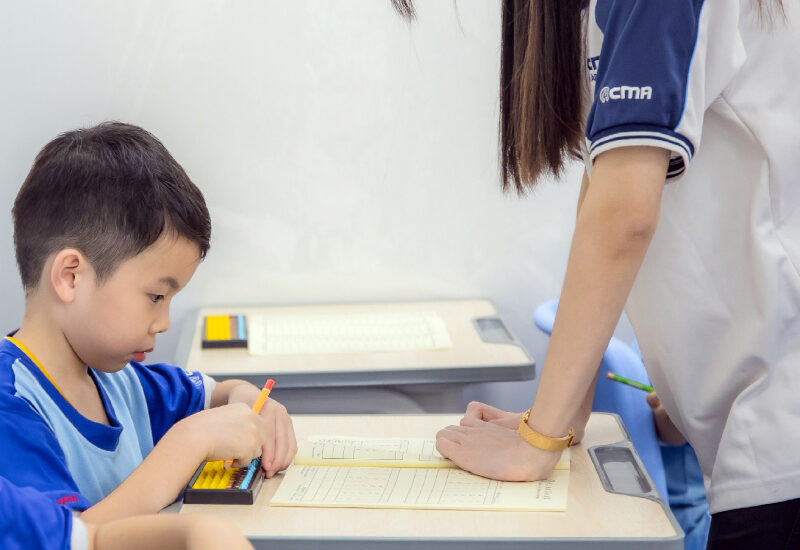
When most people picture an abacus class, they think of children moving beads quickly and arriving at answers faster than a calculator. Speed is the visible outcome. But for parents considering abacus training as a form of cognitive skills training for their child, the more important question is what is happening underneath that speed, inside the developing brain, with each session of structured practice.
The answer, supported by research in developmental psychology and educational neuroscience, is considerably richer than calculation velocity alone. Abacus mental arithmetic training consistently links to the development of several core cognitive skills that shape how children learn across every subject, not just mathematics.
Does Abacus Training Really Improve Working Memory?
Working memory is the brain’s active mental workspace. It holds information in mind while the brain is using it, which is essential for following multi-step instructions, reading with comprehension, and working through complex problems without losing track of earlier steps.
During abacus training, children must simultaneously hold the current state of the beads in mind, recall the relevant arithmetic formula, and track the result of each movement as the calculation progresses. This places a direct and consistent demand on working memory with every problem solved. Over months of regular practice, this repeated demand strengthens the brain’s capacity to hold and manipulate information actively, producing working memory gains that transfer beyond arithmetic into general academic learning.
CMA Singapore’s 2010 research programme examined the outcomes of children who completed CMA’s abacus mental arithmetic curriculum and found measurable improvements in cognitive performance areas consistent with working memory and numerical processing development.
How Does Abacus Training Develop Visuospatial Reasoning?
Visuospatial reasoning is the ability to mentally visualise, organise, and manipulate objects and information in space. It underpins skills like geometry, map reading, pattern recognition, and the ability to mentally picture a problem before solving it.
The abacus is inherently a visual and spatial tool. Children must track the position of beads across multiple columns, understand the spatial value each position represents, and mentally anticipate where beads need to move before executing the movement. As children progress into mental arithmetic, this spatial demand intensifies significantly. The child must now hold a complete imaginary abacus in their mind and manipulate it mentally with no physical reference.
This sustained practice in mental visualisation builds visuospatial reasoning capacity that researchers have noted as a particularly distinctive outcome of abacus training compared to conventional arithmetic instruction. Children who develop strong visuospatial skills through abacus mental arithmetic tend to approach spatial and geometric challenges with greater fluency and confidence across their broader learning.
What Does Abacus Training Do for Sustained Attention?
Sustained attention is the ability to maintain focus on a single demanding task for a meaningful period without losing accuracy or mental engagement. It is one of the cognitive skills most directly linked to academic performance and one of the most difficult to develop through passive learning activities.
Each abacus session places a genuine and escalating demand on sustained attention. The child must remain focused throughout a series of calculations, maintain accuracy across multiple steps, and resist distraction in order to produce correct results. Unlike passive content that holds attention automatically, the abacus requires the child to hold their own attention voluntarily throughout the task.
Structured attention training for kids through regular abacus practice builds this voluntary attention capacity progressively. The progressive level structure in CMA’s programmes ensures children are always working at a difficulty level that genuinely challenges their current attention span rather than falling below the threshold of meaningful effort.
Does Abacus Practice Improve Processing Speed?
Processing speed refers to how quickly the brain can take in information, interpret it, and produce an accurate response. In academic settings, it influences how efficiently a child completes timed assessments, follows fast-paced classroom instruction, and shifts between tasks without losing momentum.
Abacus training builds processing speed through repeated, timed practice at progressively higher difficulty levels. As children advance through CMA’s curriculum from Foundation through to the Dan Levels of the Primary Programme, the pace and complexity of calculations increase alongside their developing capacity. The brain adapts to this escalating demand by processing numerical and spatial information more efficiently over time.
This improvement in processing speed has practical implications beyond mathematics. Children who process information faster across sensory and cognitive channels tend to feel less overwhelmed in busy academic environments and more confident in situations that require quick thinking.
How Does Abacus Training Build Mathematical Confidence?
Mathematical confidence is not a cognitive skill in the clinical sense, but it is one of the most practically significant outcomes of effective cognitive skills training in children. A child who approaches numbers with ease and a sense of capability learns mathematics differently from one who approaches it with anxiety or avoidance.
Abacus training builds mathematical confidence through a specific mechanism: it gives children concrete, visible proof of their own growing ability. Each level completed, each calculation solved accurately, and each transition from physical to mental arithmetic represents a genuine achievement that the child can feel and measure. This pattern of consistent, earned success builds an internal sense of numerical competence that accompanies children into their broader mathematical learning.
At CMA Singapore, programmes are structured around ability-based progression from as young as 3 years old, ensuring that every child experiences this pattern of challenge, achievement, and advancement at a pace that builds confidence rather than pressure.
Is Abacus Training One of the Best Cognitive Skills Training Programmes for Kids in Singapore?
For parents looking at the landscape of cognitive skills training programmes available for children in Singapore, abacus mental arithmetic stands out for one important reason: it develops multiple core cognitive skills simultaneously within a single structured activity rather than targeting one skill in isolation.
Working memory, visuospatial reasoning, sustained attention, processing speed, and mathematical confidence are all engaged and developed through the same practice session. This breadth of cognitive engagement, delivered through a progressive, structured curriculum that grows with the child, makes it one of the most efficient and well-evidenced forms of cognitive skills training available for children from preschool through to primary school age.
If you would like to learn more about CMA Singapore’s programmes and how they support your child’s cognitive development, visit our centres or speak with our team about the right starting point for your child’s age and stage.
Frequently Asked Questions (FAQ)
Q1: How is cognitive skills training different from academic tutoring for children?
Academic tutoring focuses on specific subject content, helping children understand or practise what is being taught in school. Cognitive skills training targets the underlying mental processes used to learn any subject, including attention, working memory, processing speed, and reasoning. The two serve complementary purposes, and children who receive both subject support and structured cognitive training generally benefit more than those who receive only one.
Q2: Is abacus training only useful for children who are already good at maths?
No, abacus training is designed to build the cognitive foundations that support mathematical learning rather than requiring existing maths ability as a prerequisite. Children who find numbers challenging often benefit significantly from abacus training because it builds numerical confidence and working memory from the ground up. CMA Singapore’s ability-based progression ensures every child starts at the level appropriate to their current readiness regardless of prior maths performance.
Q3: Where can parents in Singapore enrol their child for abacus and cognitive skills training?
CMA Singapore is one of the most established abacus mental arithmetic centres in Singapore, offering structured cognitive skills training programmes for children from age 3 to 13 across multiple locations island-wide. Programmes are available at several branches including centres in the north, east, and central regions of Singapore. Parents can visit the nearest CMA Singapore’s centres or reach out directly to enquire about the right programme for their child’s age and stage.
Q4: At what age should a child start abacus training to get the most cognitive development benefit?
Starting between ages 3 and 6 provides the longest window of benefit because the brain is at its most responsive to structured cognitive engagement during early childhood. CMA Singapore’s Kindy Programme accepts children from age 3, introducing abacus concepts through play and songs in a stress-free environment suited to this developmental stage. Children who begin earlier accumulate a compounding cognitive advantage that builds progressively through each level of the programme.
Q5: How does abacus training compare to other cognitive skills training programmes for kids in Singapore?
Most cognitive enrichment programmes focus on one or two skill areas, such as memory or reasoning. Abacus training is distinctive in developing working memory, visuospatial reasoning, sustained attention, and processing speed simultaneously within a single structured session. This multi-skill engagement, combined with a clear progressive level system and strong research backing including CMA’s own 2010 study, makes it one of the most comprehensive cognitive skills training options available for children in Singapore.