
- August 18, 2026
- Posted by: webmaster
- Category: Blog
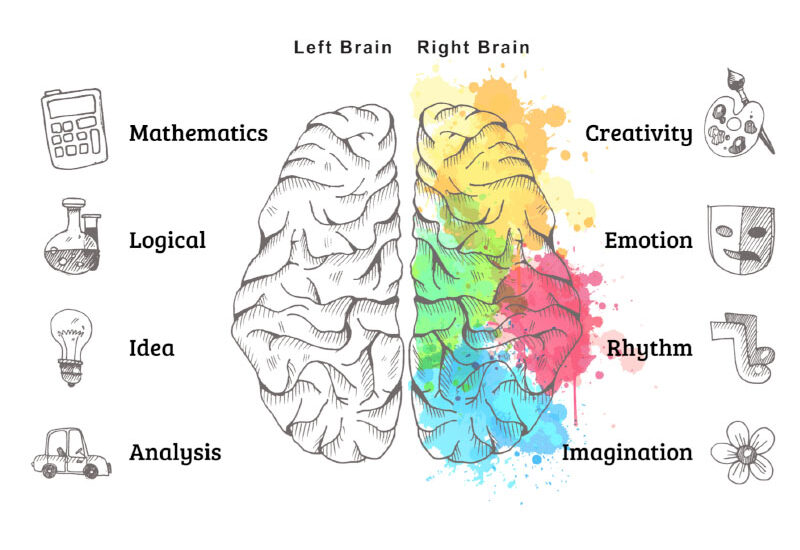
Most parents have come across the idea that people are either left-brained or right-brained. The left brain is associated with logic and numbers, the right brain with creativity and imagination. While modern neuroscience has moved beyond the idea that people are strictly one or the other, the underlying concept that different parts of the brain handle different types of thinking remains a useful and well-supported framework for understanding how children learn.
What this means for parents choosing brain development programmes for kids is significant. A programme that engages only one side of the brain is leaving half the picture untrained.
What the Left Brain Handles
The left hemisphere of the brain is generally associated with logical, sequential, and analytical thinking. It processes language, handles step-by-step reasoning, manages numerical calculation, and organises information in a structured way.
In practical terms, left-brain functions are what a child draws on when they follow a set of instructions in order, work through a maths problem step by step, read and decode written language, or recall a fact accurately from memory.
Children with well-developed left-brain function tend to be methodical, organised, and comfortable with structured tasks. They can break a problem down into parts and work through it systematically.
What the Right Brain Handles
The right hemisphere of the brain is associated with holistic, creative, and visual thinking. It processes spatial relationships, recognises patterns, handles imagination and visualisation, and manages the ability to see the bigger picture before the details.
In practical terms, right-brain functions come into play when a child visualises a story while reading, recognises a face or shape instantly, comes up with a creative solution to a problem, or senses the overall pattern of something before they can explain it analytically.
Children with well-developed right-brain function often have strong intuition, creative thinking, and the ability to make mental connections quickly and fluidly.
Why Children Need Both
Strong learning does not come from one hemisphere working in isolation. It comes from both hemispheres communicating and cooperating effectively. A child who is strong in logical thinking but weak in visualisation may struggle with geometry or creative problem solving. A child with strong imagination but weaker sequential processing may find structured academic tasks difficult to sustain.
This is why the most effective brain development programmes for kids are those that engage both hemispheres together rather than focusing on only one cognitive style. When both sides of the brain are trained consistently, children develop a more flexible and well-rounded capacity for learning that supports them across all subjects and environments.
How Abacus Mental Arithmetic Trains Both Sides
Abacus mental arithmetic is one of the few structured learning activities that genuinely and simultaneously engages both hemispheres of the brain throughout the learning process.
Here is how it works at each stage:
During physical abacus training, a child uses both hands to move beads on the abacus. The left hand activates the right hemisphere of the brain, while the right hand activates the left hemisphere. This dual-hand engagement means both sides of the brain are being stimulated at the same time during every session, rather than one taking over while the other rests.
The left brain is engaged through the logical, sequential process of applying arithmetic formulae and working through calculations step by step. The right brain is engaged through the spatial and visual process of tracking bead positions, recognising patterns, and managing the physical layout of the abacus.
During mental arithmetic training, which is the more advanced stage where children no longer use the physical abacus, the right-brain engagement intensifies. Children must visualise an imaginary abacus in their minds and mentally manipulate it to perform calculations. This act of sustained mental visualisation is a distinctly right-brain activity that very few other structured learning programmes actively develop.
At the same time, the left brain continues to manage the calculation logic, the recall of formulae, and the sequential process of arriving at an accurate answer. The two hemispheres work in close coordination, which is precisely what makes mental arithmetic such a powerful cognitive exercise.
What This Means for Your Child’s Development
When both sides of the brain are consistently engaged through structured training, children tend to develop stronger overall cognitive capacity. Over time, this shows up as improved concentration, faster information processing, stronger memory recall, and greater mental flexibility when approaching unfamiliar problems.
These are not skills that are limited to mathematics. They are general learning capacities that support a child’s performance and confidence across every area of school and everyday life.
For parents looking at brain development programmes for kids in Singapore, the question worth asking is not just what a programme teaches, but which parts of the brain it actually engages and whether both hemispheres are being developed consistently over time.
CMA Singapore: Built Around Whole-Brain Development
CMA Singapore’s programmes are specifically designed around the principle of whole-brain development through the dual-hand abacus method. From the earliest Kindy Programme for children aged 3, through to the advanced Dan Levels in the Primary Programme for children up to 13, every stage of the curriculum is built to engage both the left and right hemispheres together.
The dual-hand approach is not incidental to CMA’s methodology. It is central to it. By training both hands simultaneously from the very beginning, CMA ensures that children are developing both sides of the brain from their very first lesson, building a stronger and more balanced cognitive foundation with every session.
If you are exploring brain development programmes for kids in Singapore and want to find out more about how CMA’s approach works in practice, visit our centres or speak with our team to find the right programme for your child’s age and stage.
Frequently Asked Questions (FAQ)
Q1. What does whole-brain development actually mean in the context of a child’s learning?
Whole-brain development refers to engaging and strengthening both the left and right hemispheres of the brain through consistent, structured learning activities. Rather than favouring only logical or only creative thinking, whole-brain approaches train both hemispheres to work together, building a more flexible and well-rounded learning capacity that benefits children across all subjects and environments.
Q2. Are children naturally more left-brained or right-brained from birth?
While children may show early tendencies toward certain thinking styles, most developmental research suggests that both hemispheres are active and necessary from birth and that neither side is strictly dominant in healthy brain development. The degree to which each hemisphere develops is significantly shaped by the experiences, activities, and structured engagement a child receives during their early years.
Q3. How early should parents start a brain development programme for their child in Singapore?
Early childhood between ages 3 and 6 is widely considered the most responsive period for foundational cognitive development, making it an ideal window to begin structured brain development activities. CMA Singapore accepts children from as young as 3 years old through its Kindy Programme, which introduces abacus and number concepts in a play-based, stress-free environment suited to this age group.
Q4. My child is very strong in creative subjects but struggles with maths. Would abacus training help?
Yes, and children with stronger right-brain tendencies often respond well to abacus training because the visual and spatial nature of bead manipulation aligns naturally with how they process information. As the programme progresses, the structured left-brain component of arithmetic formulae is introduced gradually, helping creative children build logical and sequential thinking alongside their existing strengths.
Q5. How does the dual-hand abacus method compare to other brain development programmes for kids?
The dual-hand abacus method is distinctive in that it simultaneously activates both brain hemispheres through physical bead movement with both hands, combined with the progression into mental visualisation at advanced stages. Many other brain development programmes tend to focus more heavily on either creative or analytical skills. The abacus method is one of the few structured activities that consistently engages both hemispheres within a single session.